

UX debt is the design equivalent of technical debt – small compromises made during development to save time or resources that eventually lead to larger usability problems. For SaaS products, this can mean clunky workflows, inconsistent interfaces, or accessibility issues that frustrate users and hurt retention.
Key Points:
- What is UX Debt? It’s the gap between your product’s current user experience and the ideal one.
- Why It Happens: Tight deadlines, budget constraints, and rapid growth often lead to design shortcuts.
- How It Grows: Over time, these small issues compound, creating "Frankenstein" products with confusing workflows and outdated designs.
- Impact: UX debt increases support tickets, slows down teams, and pushes users to competitors.
- Solutions: Regular UX audits, prioritizing fixes, and tracking issues in a UX debt register help manage and reduce the problem.
Ignoring UX debt isn’t just a design issue – it directly affects user satisfaction, retention, and revenue. Fixing it requires treating it as an ongoing process, with structured reviews, prioritization, and integration into development cycles.
What Causes UX Debt to Build Up
Deliberate UX Debt: Speed Over Quality
Most UX debt doesn’t happen by chance – it’s often the result of deliberate decisions. Teams knowingly release products with design flaws when speed to market takes priority over perfection. In competitive environments, being the first to launch can be the difference between leading the market and struggling to catch up. Bansi Mehta, CEO of Koru UX, explains it well:
"Design debt is the residual work you collect by taking shortcuts during or after the design phase." [5]
Agile development cycles add even more pressure. Sprint deadlines demand quick turnarounds, often at the expense of critical steps like user testing or thorough documentation. In fast-paced "fail-fast" cultures, essential processes like analysis, design, and hand-offs are squeezed into tight timelines, prioritizing speed over quality. Budget constraints and the need to satisfy stakeholders often push teams to chase short-term wins, resulting in disconnected, patchwork designs.
While these trade-offs are intentional, unintentional issues also play a major role in the accumulation of UX debt.
Accidental UX Debt: Oversights and Growing Pains
Not all UX debt stems from conscious choices. As products grow, complexity tends to increase naturally unless teams actively work to manage it. This phenomenon, explained by Lehman’s Law of Increasing Complexity, highlights how software systems become more intricate over time without deliberate intervention [4]. In SaaS products, this often results in what’s sometimes called a "Frankenstein app", where features feel cobbled together rather than cohesive.
Silos within teams can exacerbate the problem. For instance, when separate teams create similar functionalities for different platforms – like mobile and web – without a unified design system, the result is inconsistent UI elements and clashing terminology. Intercom tackled this issue by consolidating their messaging systems, which led to a 33% drop in customer conversations flagged with "product confusion" [8].
Rapid growth can also contribute to UX debt. When teams expand or companies switch vendors, the reasoning behind earlier design decisions often gets lost, leaving new team members to guess at the original intent. This lack of continuity can lead to decisions that further complicate the product.
Accessibility debt is another common problem. Many older pages fail to meet the recommended 4.5:1 text-to-background contrast ratio. For example, a Symantec investor page was found to have a contrast ratio of just 3.2:1 [1]. These kinds of oversights often go unnoticed during development and remain unresolved for years.
Three Steps to Resolve UX Debt
How UX Debt Hurts SaaS Retention and Growth
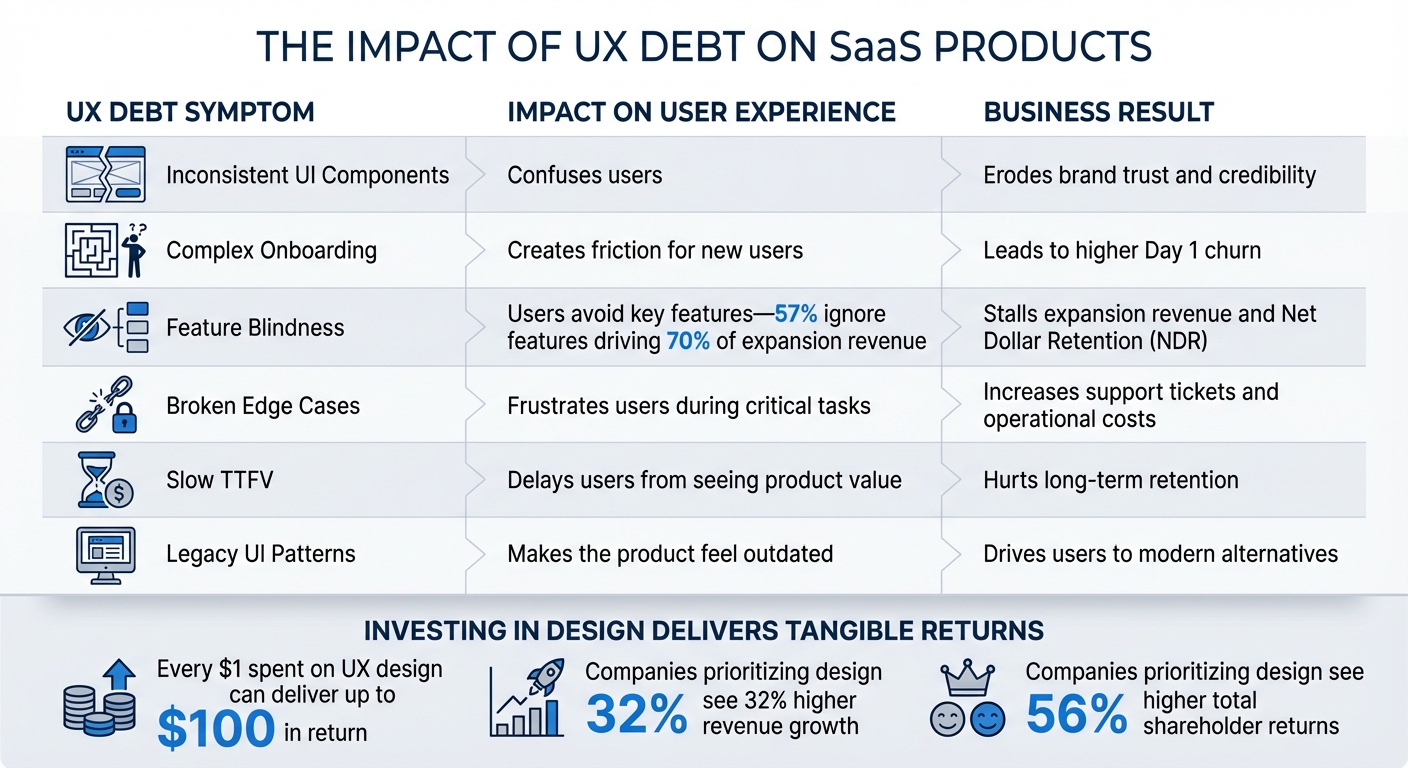
UX Debt Impact on User Experience and Business Outcomes
UX Debt’s Effect on User Satisfaction
UX debt doesn’t just make products harder to use – it actively drives users away. When even simple tasks feel like puzzles, users lose patience fast. Instead of smoothly navigating through the product, they find themselves stuck asking, “Where is this button?” or “How do I do this again?” This constant troubleshooting interrupts their ability to experience the product’s value [9].
These usability roadblocks slow down the Time to First Value (TTFV), leaving users frustrated as they repeatedly search for basic functions [9]. Even worse, users often develop workarounds to avoid friction points, which leads to feature blindness. For example, 57% of active users never touch features that generate 70% of expansion revenue [10].
Anna Kaley, a Senior User Experience Specialist at Nielsen Norman Group, sums it up perfectly:
"Launching a suboptimal design impacts long-term market share, because many customers will give you one try and then give up when the design is too difficult or doesn’t satisfy their needs." [1]
Products that feel clunky or disjointed also harm professional credibility. Users notice inconsistencies, and these small annoyances chip away at trust. When competitors offer even slightly smoother experiences, it becomes all too easy for users to jump ship [9][12].
And the impact doesn’t stop with users – it creates headaches for internal teams too.
How UX Debt Slows Down Teams
The ripple effects of UX debt extend beyond user frustration. For one, it creates a surge in support tickets as users struggle with basic functionality. On top of that, gaps in documentation force team members to spend extra time piecing together lost context [9][12][3].
Development teams also feel the strain. Revisiting old features bogged down by UX debt often takes more time and resources than addressing design issues proactively [1].
| UX Debt Symptom | Impact on User Experience | Business Result |
|---|---|---|
| Inconsistent UI Components | Confuses users | Erodes brand trust and credibility [9] |
| Complex Onboarding | Creates friction for new users | Leads to higher Day 1 churn [9] |
| Feature Blindness | Users avoid key features – 57% ignore features driving 70% of expansion revenue | Stalls expansion revenue and Net Dollar Retention (NDR) [10] |
| Broken Edge Cases | Frustrates users during critical tasks | Increases support tickets and operational costs [9] |
| Slow TTFV | Delays users from seeing product value | Hurts long-term retention [9] |
| Legacy UI Patterns | Makes the product feel outdated | Drives users to modern alternatives [2] |
The numbers don’t lie. Every $1 spent on UX design can deliver up to $100 in return, and companies that prioritize design see 32% higher revenue growth and 56% higher total shareholder returns [11]. Ignoring UX debt isn’t just a technical problem – it’s a direct hit to the bottom line.
sbb-itb-51b9a02
How to Find and Audit UX Debt
Now that we understand how UX debt can hurt user retention and satisfaction, let’s dive into how to identify and document these issues effectively.
Running a UX Audit
A UX audit is essentially a structured review of your product, measured against established usability principles. Start by setting clear boundaries for the audit – decide if you’re examining the entire user experience or focusing on specific areas like onboarding or checkout processes.
Use frameworks like Nielsen’s 10 Usability Heuristics to check for consistency. For instance, ensure that UI elements such as buttons and navigation are placed consistently across screens. Don’t overlook accessibility – text contrast ratios should meet a minimum of 4.5:1 for normal-sized text [1].
As you go through the audit, categorize what you find. Functional debt includes broken features. For example, in November 2018, Amazon’s shipping-for-returns page mistakenly displayed "Returning 2 items" for a 4-item return, leaving users confused about their refunds [1]. Visual debt involves inconsistent UI patterns, while documentation debt refers to outdated design specs that leave teams guessing [3].
Using User Feedback and Testing
While expert audits can catch design inconsistencies, usability testing uncovers the real issues users face. Monthly testing of key user flows can help identify friction points that might otherwise go unnoticed [1].
Anna Kaley from Nielsen Norman Group highlights why this matters:
"The cost of having to go back and fix problems after launch is always higher than launching ideal solutions in the first place (i.e., the debt is repaid with usurious interest)." [1]
To stay ahead, gather feedback from multiple sources like customer support tickets, on-site surveys, and NPS scores. These can act as early warning signs for problems. Document these insights to create a clear plan of action.
Creating a UX Debt Register
Keeping track of your findings is essential. A UX debt register – a centralized tracker like a spreadsheet or a tool such as Trello – ensures that issues don’t slip through the cracks. Include key details like the issue description, its location in the user journey, how often it occurs, who reported it, and an estimated effort to fix (low, medium, or high) [1].
| Debt Category | Description | Example |
|---|---|---|
| Quick Win | Small scope, fixable in one sprint | Updating instructional copy or fixing spacing [7] |
| Optimization | Local issue requiring 1–2 sprints | Aligning outdated UI patterns with current designs [7] |
| Redesign Effort | Complex problem needing research | Overhauling a multi-screen billing workflow [7] |
Some teams set aside dedicated time to address UX debt. For instance, a "Cheese Day" every 60 days focuses exclusively on quick fixes [5]. Others assign specific story points in each sprint to tackle UX debt [1]. The goal is to keep this debt visible and manageable, ensuring it doesn’t pile up over time.
How to Fix UX Debt Without Breaking Your Product
Once you’ve pinpointed and documented your UX debt, the real challenge is figuring out how to tackle it without disrupting your product’s day-to-day operations. The trick lies in treating UX debt as an ongoing process rather than a one-time cleanup effort.
Prioritizing UX Debt with Data
Not every UX issue demands your immediate attention. To decide where to start, rank problems on a User Value vs. Development Effort matrix [1]. This method highlights "Quick Wins" – those high-impact fixes that require minimal effort.
Start by focusing on critical user journeys like onboarding, checkout, or workflows tied directly to revenue and retention. These areas typically matter more than less essential pages, such as invoice generation [5]. Use data from customer support, analytics, and user feedback (look for tags like "#customer-confusion") to identify where the biggest pain points lie.
This approach ensures you’re solving problems that matter most to your users and your business. Once priorities are clear, it’s time to fold these fixes into your development process.
Adding UX Debt Fixes to Development Sprints
After prioritizing, the next step is to integrate UX debt fixes into your development cycles. A practical way to manage this is by dedicating 10-15% of your sprint capacity to resolving UX debt [1]. This keeps the debt from piling up while still allowing room for new feature development.
Many teams treat UX debt issues as bugs, running them through the same review and prioritization process as other defects. Others categorize fixes by scope:
- Quick Wins: Changes that can be resolved in a single sprint.
- Optimizations: Tasks requiring one to two sprints.
- Redesign Efforts: Larger projects needing dedicated research and planning [7].
For more complex issues, consider setting aside one sprint per quarter exclusively for cleanup. This ensures steady progress while balancing ongoing feature delivery [1].
How AlterSquare Helps Reduce UX Debt
Once you’ve integrated debt fixes into your sprints, having strategic support can make a big difference. AlterSquare offers UI/UX design services and post-launch support specifically designed to help SaaS teams tackle UX debt without slowing down new development.
Their I.D.E.A.L. framework – which includes discovery, design, agile development, launch preparation, and continuous improvement – seamlessly incorporates debt resolution into your product roadmap. Rapid prototyping sprints allow you to visualize workflows early, catching usability issues before development begins.
AlterSquare also conducts regular usability testing and maintains robust design systems, which not only address existing debt but also help prevent new debt from forming. For teams handling legacy products, their application modernization services can refresh outdated interfaces without interrupting live operations, offering users a smoother, gradual transition to improved designs.
Conclusion: Managing UX Debt for Better Results
UX debt is an ongoing challenge for any SaaS product that evolves over time. Tackling it effectively means staying proactive rather than waiting for issues to pile up. Regular evaluations – like heuristic reviews, usability testing, and gathering user feedback – can help you spot problems early, before they grow into larger obstacles.
Keep track of these issues with a dedicated UX Debt Register. Organize them into categories such as Quick Wins, Optimizations, or Redesign Efforts, so they don’t get lost in the shuffle of new development. Once you’ve identified areas of concern, act swiftly. Focus on fixes that have the greatest impact, especially in critical areas like onboarding or checkout, where even small friction points can hurt retention and revenue. Tools like a User Value vs. Development Effort matrix can guide you in prioritizing changes that deliver the most value with the least effort.
Make UX debt resolution a regular part of your workflow. Allocate story points during sprints or set aside time for quarterly cleanup sessions to ensure progress is consistent [1][13]. This kind of structured approach, combined with regular audits, keeps UX debt from spiraling out of control.
Building a proactive culture is essential. Maintain a living design system, involve developers early in the design process, and keep an eye on key UX metrics like NPS and bounce rates to catch potential issues early. When you make improvements based on user feedback, let your users know – they’ll appreciate the transparency, and it strengthens their trust in your product [6].
Managing UX debt isn’t about perfection. It’s about making steady, meaningful progress. Teams that succeed see usability not as a one-time task but as an ongoing commitment to delivering a better experience for their users.
FAQs
How can we prioritize fixing UX debt in our SaaS product efficiently?
To tackle UX debt effectively, start by compiling a comprehensive list of usability issues. Collaborate with your team to thoroughly review the product and document any design or functionality problems. Then, assess each issue based on two key factors: impact (how it influences users, churn rates, or revenue) and effort (the time and resources needed to address it). An impact-vs-effort matrix can help you prioritize – focusing on quick wins (high impact, low effort) and critical fixes (high impact, high effort) while setting aside lower-priority items.
In agile workflows, consider dedicating a portion of each sprint (around 20%) to resolving the most pressing UX debt. Use usability testing or analytics to validate your priorities, ensuring you’re addressing real user challenges. Concentrate on areas that align with business objectives, such as optimizing high-traffic sections like checkout processes before tackling less frequently used features. Make it a habit to revisit the backlog during planning sessions to prevent unresolved issues from accumulating. This methodical approach ensures steady product improvement without disrupting everyday operations.
How can SaaS teams prevent UX debt from building up over time?
Preventing UX debt in SaaS products takes consistent effort and smart planning. A good starting point is creating a UX debt inventory – a detailed list of usability problems, inconsistencies, or missing accessibility features. By keeping this inventory up-to-date, you can review and prioritize these issues during sprint planning, ensuring they’re addressed alongside new feature development.
Another key step is conducting regular usability testing and user research. Testing new features or areas with high user activity can highlight problems early, making them easier to fix before they become deeply embedded. If quick releases require temporary compromises, make sure to schedule follow-up sprints to revisit and resolve these shortcuts. Additionally, maintaining a design system can help enforce consistency across your product, reducing the chance of new UX debt piling up.
By weaving UX debt management into your regular workflows, you’ll not only improve your product’s usability but also strengthen user satisfaction over time.
How does UX debt affect user retention and satisfaction in SaaS products?
UX debt can take a serious toll on user retention and satisfaction by introducing unnecessary friction into the user experience. Issues like inconsistent navigation, outdated design elements, or confusing workflows can pile up over time, making your product feel clunky and difficult to use. These small annoyances might seem minor at first, but they can gradually chip away at user trust and push people toward alternatives – leading to higher churn rates.
When usability problems linger, user satisfaction takes a hit. Frustration builds as the product feels less reliable or polished, and even small inconsistencies can leave a bad taste, shaking user confidence. Tackling UX debt early ensures your product stays smooth and user-friendly, keeping your audience engaged and loyal.








Leave a Reply