
As a non-technical founder, deciding between outsourcing and building an in-house team is crucial for your startup’s success. Here’s the quick answer:
- Outsourcing is faster, cheaper upfront, and gives access to global talent for specialized skills. It’s ideal for launching an MVP quickly or working with a limited budget.
- In-House Teams offer more control, deeper alignment with your vision, and long-term expertise. This is better for core products requiring ongoing updates and a stable team.
Key Differences:
- Cost: Outsourcing saves on salaries and overhead, while in-house teams are more expensive.
- Speed: Outsourcing can start in weeks; in-house hiring takes months.
- Control: In-house teams provide direct oversight; outsourcing relies on vendor contracts.
- Expertise: Outsourcing taps global skills; in-house teams depend on local hires.
Quick Comparison:
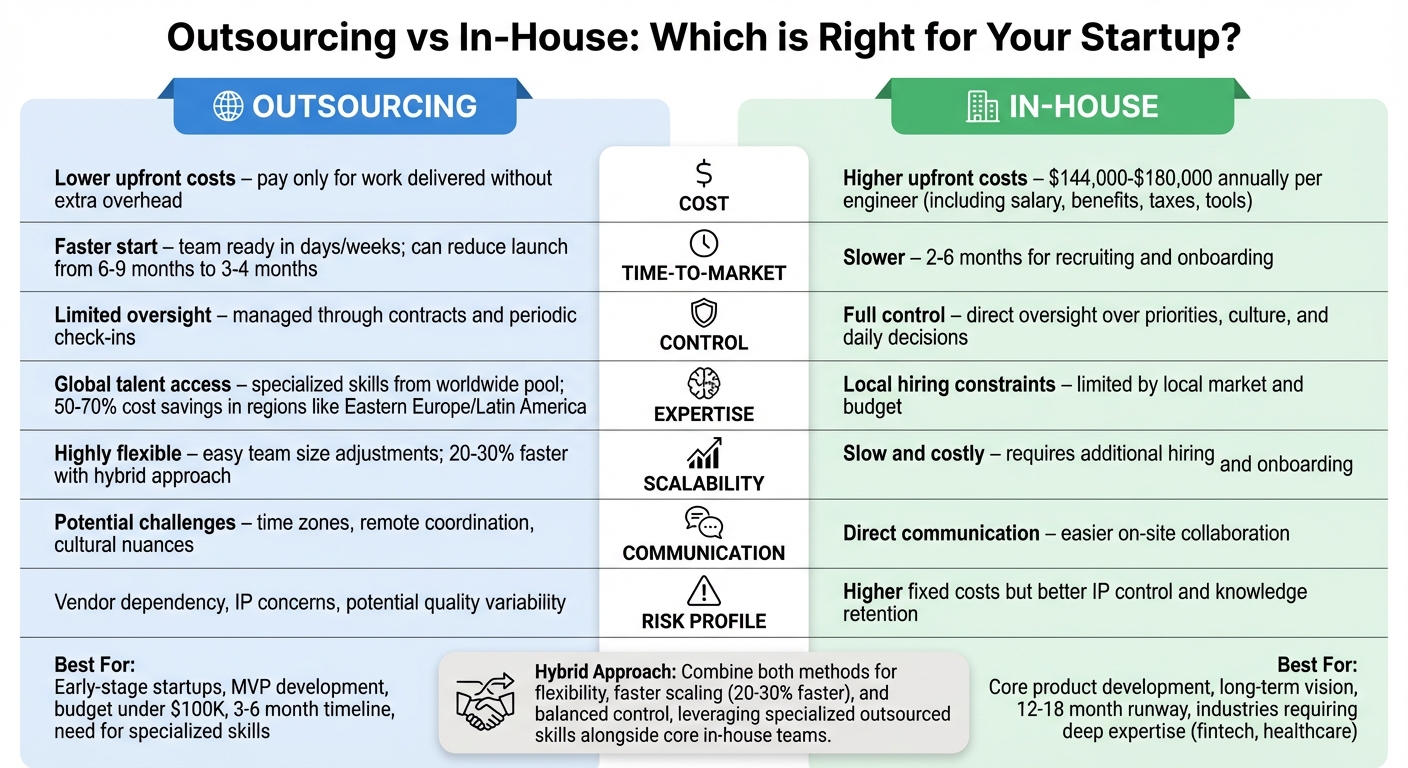
| Factor | Outsourcing | In-House |
|---|---|---|
| Cost | Lower upfront costs | Higher fixed costs |
| Time-to-Market | Faster start | Slower due to hiring delays |
| Control | Limited oversight | Full control |
| Expertise | Global talent access | Local hiring constraints |
| Scalability | Flexible team adjustments | Slow and costly scaling |
Outsourcing works best for early-stage startups needing speed and flexibility, while in-house teams are better for long-term product development. A hybrid approach – outsourcing specialized tasks while keeping strategic roles in-house – can balance the pros and cons of both.
Outsourcing vs In-House Development: Complete Comparison for Startups
Outsourcing for MVP Development: Pros and Cons
Pros of Outsourcing
Outsourcing can be a cost-effective option for startups, especially when budgets are tight. Instead of covering full overhead costs like salaries, benefits, office space, and equipment, you only pay for the specific deliverables. For early-stage companies trying to validate their ideas, this helps keep the burn rate low. Many startups turn to regions like Eastern Europe, Latin America, and Southeast Asia, where developer rates are significantly lower than in the U.S., allowing them to stretch their budgets further.
Another advantage is speed. Outsourced teams can get started within days or weeks, bypassing the often lengthy hiring process. Some startups have managed to cut their launch timelines from 6–9 months to just 3–4 months by outsourcing[3][5]. EPAM Startups & SMBs highlights how outsourcing can "drastically reduce operating costs and overhead"[3].
Outsourcing also opens the door to specialized expertise. Whether you need skills in generative AI or advanced UI/UX design, you can tap into a global talent pool to find the exact capabilities your project requires – without the expense of hiring locally.
Finally, outsourcing offers flexibility. You can scale your team up or down as your project evolves, avoiding the fixed commitments of a traditional payroll.
While these benefits can make outsourcing appealing, there are also challenges to consider.
Cons of Outsourcing
One common challenge is communication. Time zone differences and cultural nuances can lead to delays or misalignment in project updates.
Another drawback is the reduced level of daily control. Since you’re working through a vendor, it can be harder to make rapid changes or pivots. A survey by Compuware Corporation found that outsourcing, when not managed effectively, can sometimes impact software quality and development speed[2].
There’s also the risk of vendor dependency. This includes potential intellectual property (IP) concerns, loss of expertise, and continuity issues if key members of the outsourced team leave.
Comparison Table: Outsourcing vs In-House
The table below highlights the main differences between outsourcing and building an in-house team:
| Factor | Outsourcing | In-House |
|---|---|---|
| Cost | Lower upfront costs; pay only for work delivered without extra overhead | Higher upfront costs, including salaries, benefits, and office expenses |
| Time-to-Market | Faster start with pre-staffed teams and established processes | Slower due to hiring, onboarding, and team formation |
| Control | Less direct oversight; managed through contracts and periodic check-ins | Full control over priorities, culture, and daily decisions |
| Communication | Potential challenges with time zones and remote coordination | Easier, direct communication with on-site teams |
| Expertise | Access to a global talent pool offering specialized skills | Limited by the local hiring market and budget constraints |
| Scalability | Highly flexible; team size can be adjusted as needed | Scaling requires additional hiring, which can be slow and costly |
| Risk Profile | Involves vendor dependency, IP concerns, and potential quality variability | Entails higher fixed costs but better control over intellectual property and knowledge retention |
Next, we’ll dive into how building an in-house team compares when addressing these factors.
In-House Teams for MVP Development: Pros and Cons
Pros of In-House Teams
Having an in-house team means you’re in the driver’s seat when it comes to decision-making, quality control, and setting priorities. There’s no need to navigate external contracts or wait for approvals – your team can act quickly. For instance, if a customer flags a bug or suggests a feature tweak, your in-house developers can jump on it right away.
These developers aren’t just employees – they’re part of your company’s DNA from the get-go. By sitting in on meetings, hearing customer feedback firsthand, and aligning with your mission, they gain a deep understanding of your goals. This shared context helps them refine vague ideas, suggest smarter solutions, and maintain a high standard of code quality. Over time, they also build institutional knowledge – like understanding past decisions, tricky edge cases, and the system’s architecture – which speeds up onboarding for new hires and reduces reliance on outside vendors.
For industries that demand deep expertise – think fintech platforms with intricate regulations or healthcare apps with strict compliance standards – having engineers who truly understand your business can lead to a more cohesive user experience and higher-quality products.
Cons of In-House Teams
While the benefits are clear, in-house teams come with their own set of challenges. The most obvious? Cost. In the U.S., the total cost of hiring an engineer – including salary, benefits, taxes, and tools – can range from $144,000 to $180,000 annually for someone earning a $120,000 base salary[6][3][5]. By comparison, outsourcing a 4-week prototype sprint could cost less than what you’d pay a senior developer in a single month[1].
Then there’s the time factor. Recruiting and onboarding even a small team of engineers can take anywhere from 2 to 6 months in a competitive job market like the U.S.[3][5]. For non-technical founders, this process can be even trickier. Without the ability to accurately assess technical skills, the risk of making a costly hiring mistake increases.
Flexibility is another issue. Scaling up your team takes time due to lengthy recruitment cycles, and scaling down often means layoffs – which can hurt morale and disrupt company culture. If your MVP requires specialized skills, like advanced AI, DevOps, or mobile app development, your in-house team might not have the expertise, leaving you to either delay features or stretch your developers too thin.
Lastly, managing an in-house team is no small feat, especially for non-technical founders. Without a technical co-founder or experienced leader, you might face challenges like poor architectural decisions, mounting technical debt, and inconsistent quality. This is where expert guidance becomes crucial. Services like those from AlterSquare can step in, offering fractional CTO support, technical advisory, and structured development processes to help bridge the gap and keep your project on track.
Lecture 25 : Outsourcing vs In House Development | MVP Masterclass
Managing and Communicating with Your Team: What Non-Tech Founders Need to Know
Non-tech founders often worry about losing control over their product vision. The good news? With the right tools and strategies, you can effectively manage both in-house and outsourced teams – even if you’re not a technical expert. Let’s break down how communication dynamics differ between these two setups.
An in-house team gives you the advantage of direct oversight and instant communication. Need an update? You can simply walk over to a developer’s desk and get answers on the spot. However, if your team works remotely, this immediacy can fade. Outsourced teams, meanwhile, come with their own set of challenges – like time zone differences, cultural nuances, and the perception of being “external.” Thankfully, modern engineering-as-a-service models are bridging these gaps by integrating more seamlessly with businesses.
To keep things running smoothly, establish clear communication channels from the start. Tools like Slack or Microsoft Teams are great for messaging, while Zoom or Google Meet work well for calls. For project tracking, platforms like Jira or Trello can help keep everyone on the same page. Track metrics such as response times (aim for under 24 hours), sprint velocity, and milestone delivery to ensure communication stays on track.
Consistency is key. A structured routine can be even more effective than physical proximity. Daily video standups, weekly reviews with defined KPIs, and detailed documentation (like user stories, wireframes, and specifications) make sure your vision is crystal clear. For outsourced teams, overlapping work hours or asynchronous updates – such as recorded videos or comprehensive reports – can help address time zone differences. A hybrid approach, where core strategic roles are kept in-house while specialized tasks are outsourced, can even speed up project timelines by 20–30% [2][4].
Modern outsourcing providers, like AlterSquare, are reshaping how distant teams operate. They offer tools like direct messaging channels, daily standups, and transparent dashboards, making them feel like an extension of your product team rather than a separate vendor. This approach provides real-time visibility and flexibility that rivals in-house setups, ensuring your product vision stays intact no matter where your team is located.
Whether you opt for an in-house, outsourced, or hybrid model, the essentials remain the same: frequent check-ins, clear expectations, and the right tools will keep your team aligned and your vision on track.
sbb-itb-51b9a02
When Outsourcing Makes Sense for Non-Tech Founders
Let’s dig into when outsourcing becomes the go-to solution for non-technical founders. If you’re racing to validate an idea, working with limited funds, or need hard-to-find expertise, outsourcing can deliver what in-house teams often cannot. These scenarios highlight how outsourcing can provide the speed and flexibility startups need to thrive.
Speed is often the driving factor. When you need to launch a minimum viable product (MVP) quickly, outsourcing eliminates the lengthy process of hiring and onboarding an in-house team. Instead of spending 3–6 months recruiting and vetting developers, you can assemble a skilled team in just a few weeks. For startups facing tight deadlines or trying to outpace competitors, this rapid access to talent can be the difference between success and missing the market window[2][5].
Tight budgets make outsourcing especially attractive for early-stage founders. Rather than covering salaries, benefits, office expenses, and recruitment costs, you’re only paying for the work delivered. This approach can make outsourcing 2–3 times cheaper initially than building an in-house team, especially in regions with high salaries[3][4]. For founders trying to validate a concept or stretch limited funds before securing seed investment, this cost efficiency is a game-changer.
Outsourcing also shines when your project demands specialized skills. Let’s say your MVP relies on cutting-edge technologies like generative AI, advanced UI/UX design, or specific tech stacks like Vue.js or GoLang. Finding and affording local experts in these areas can be challenging. Outsourcing firms give you access to a global talent pool, offering all the expertise you need without the hassle of hiring multiple full-time specialists[3][4]. This flexibility is invaluable when different phases of development require distinct skills.
Another key advantage of outsourcing is the flexibility and scalability it offers. If your project scope evolves or you’re unsure about long-term development needs post-launch, outsourcing allows you to scale resources up or down easily. You avoid fixed payroll expenses and the challenges of layoffs if priorities shift. For non-technical founders, outsourcing also shifts the burden of recruitment, training, and technical delivery to the vendor. This frees you to focus on your business strategy without needing deep technical oversight[3][5].
In scenarios like these, outsourcing – especially through engineering-as-a-service models like AlterSquare – becomes a practical and efficient choice for non-tech founders aiming to bring their vision to life.
AlterSquare: Engineering-as-a-Service for Non-Tech Founders
Navigating the world of tech development can be daunting for non-technical founders. Traditional outsourcing often comes with its own set of challenges – poor communication, lack of accountability, and the dreaded technical debt. AlterSquare offers a solution that bridges the gap: an engineering-as-a-service model that integrates directly with your startup. Based in Mumbai, AlterSquare acts as an extended tech team, working alongside you to ensure smoother workflows, better communication, and predictable costs and timelines.
Their approach is built on transparency and collaboration. With a phased process that includes daily standups, regular check-ins, and real-time dashboards on Slack, AlterSquare provides the kind of visibility usually associated with an in-house team. For founders worried about "black box" development, this setup ensures you stay informed every step of the way – without the added burden of hiring, managing benefits, or maintaining office space.
One of their standout offerings is the 90-day MVP program, tailored for early-stage startups. This program combines rapid prototyping, tech stack consultations, and AI-driven tools to speed up development while keeping costs under control. What’s more, they promise zero technical debt, ensuring your code is built to scale from day one. This reduces risks and sets a solid foundation for future growth.
The results speak for themselves. AlterSquare has a track record of rescuing struggling projects and delivering critical features in tight timelines. For example, they helped scale a sales performance management platform through software modernization and team augmentation. Similarly, Foyr Neo, a 3D interior design SaaS platform, overcame significant challenges with AlterSquare’s embedded development approach. These success stories highlight how integrated tech support can drive revenue growth, improve profit margins, and enhance customer satisfaction.
For non-tech founders, AlterSquare provides a much-needed sense of control. Instead of hiring individual developers or outsourcing to an impersonal agency, you get a dedicated tech team aligned with your goals. Whether you’re building an MVP, modernizing an app, or incorporating AI-driven features, AlterSquare leverages cutting-edge technologies like Vue.js, GoLang, and Node.js to grow with you through every stage of your journey.
Conclusion: Choosing the Right Approach for Your Startup
Deciding between outsourcing and building an in-house team ultimately depends on your startup’s priorities and resources. If you’re working with a budget under $100,000 and need to launch an MVP within 3–6 months, outsourcing can be a fast and cost-effective choice. It eliminates the need for expenses like salaries, benefits, and infrastructure, while giving you quick access to specialized expertise. For instance, outsourcing to regions like Eastern Europe or Latin America can often cut costs by as much as 50–70% compared to hiring a U.S.-based in-house team[4][5].
On the other hand, if your product lies at the heart of your business and you have a longer runway – say, 12 to 18 months – investing in a small in-house team might be the way to go. This option offers greater control over your project, fosters a deeper understanding of your product, and builds long-term capabilities. However, it comes with higher fixed costs, including salaries, benefits, and tools, and it often takes longer to scale due to recruitment and onboarding challenges. A hybrid model, combining in-house leadership with outsourced expertise, can also provide a balanced alternative.
Another option to consider is the engineering-as-a-service model, which combines the speed and flexibility of outsourcing with the transparency and collaboration of an in-house team. This approach ensures clear communication and accountability while maintaining cost efficiency and quick deployment.
Each model has its own trade-offs when it comes to speed, control, and cost. If your goal is to test an idea quickly, outsourcing might be the best fit. If you’re focused on building a long-term competitive edge, an in-house team could be worth the investment. For startups seeking expert execution without the burden of overhead, partnering with a dedicated external team can strike the right balance. No matter which path you choose, clear communication, well-defined project scopes, and realistic timelines are critical to success. Missteps in these areas can derail projects, regardless of the model you select.
FAQs
What should non-technical founders consider when deciding between outsourcing and building an in-house development team?
Non-technical founders face a tough choice when deciding between outsourcing development or building an in-house team. Key factors to consider include management complexity, ease of communication, development speed, cost, scalability, and the availability of specialized skills.
Outsourcing often brings flexibility, quicker project timelines, and potential cost savings. It’s especially useful for startups aiming to launch an MVP quickly or tap into expert talent without the expense and time of hiring a full team. Companies like AlterSquare simplify this process by offering structured workflows and fast development programs, making it easier for founders to navigate their options.
On the other hand, in-house teams provide more direct control and smoother communication, which can be crucial for projects requiring constant collaboration. The right choice ultimately hinges on your goals, budget, and how involved you want to be in the development process.
What’s the best way for non-technical founders to communicate with outsourced teams?
Non-technical founders can work smoothly with outsourced teams by focusing on well-defined workflows and keeping communication consistent. Start by outlining a structured process that includes key phases like discovery, design, development, and post-launch support. This ensures everyone stays on the same page regarding goals and timelines.
Leverage collaboration tools such as project management platforms and video conferencing to stay connected. Regular check-ins and open updates help build trust and catch potential issues before they escalate. By fostering clear expectations and open dialogue, managing outsourced teams becomes far more efficient and productive.
When should startups combine in-house and outsourced development?
A hybrid development strategy is often the ideal choice for startups moving from creating a Minimum Viable Product (MVP) to scaling their offering. By blending in-house teams for key strategic responsibilities with outsourced specialists for niche or urgent tasks, startups can strike a balance between speed, quality, and control.
This method is particularly helpful for non-technical founders who might need expert advice or extra resources to meet tight deadlines. It enables startups to respond quickly to market needs while maintaining oversight of essential business elements, laying the groundwork for steady growth and future success.
Related Blog Posts
- Key Considerations for Tech Founders When Outsourcing Product Development
- Why Experienced Founders Choose Outsourced Development for Their Next MVP
- Offshore, Nearshore, or Onshore: Which Outsourcing Model Is Right for Your Startup?
- The Hidden Costs of DIY vs. Outsourced Development – and How to Avoid Them








Leave a Reply