

Scaling frontend code is straightforward compared to scaling engineering teams. Code grows linearly with tools like reusable components, CI/CD pipelines, and design systems. Teams, however, grow exponentially in complexity due to communication paths, coordination challenges, and human factors like burnout.
Key takeaways:
- Frontend scaling relies on predictable tools (e.g., monorepos, feature flags) and follows systematic patterns.
- Team scaling introduces communication overhead, misalignment, and productivity loss as team sizes increase.
- A team of 15 engineers has 105 communication paths; at 100 engineers, this grows to 4,950.
- Burnout impacts 70% of engineers during rapid growth, and organizational overhead can cost $85,000 per engineer annually.
To scale teams effectively:
- Organize teams around business domains to reduce dependencies.
- Align architecture with team boundaries for smoother collaboration.
- Use external engineering partners to handle growth surges without overburdening internal teams.
Scaling code is about tools and processes; scaling teams is about managing people and complexity.
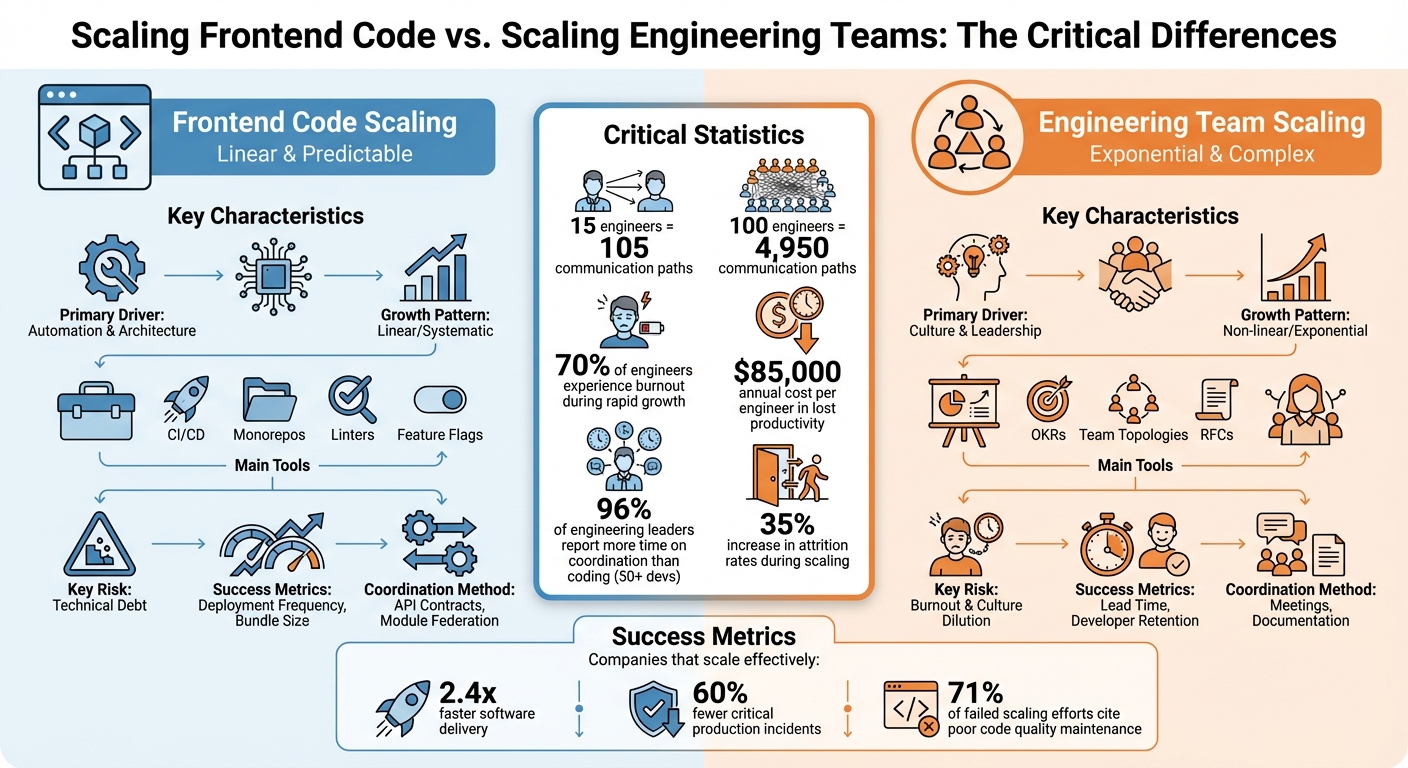
Frontend Code Scaling vs Team Scaling: Key Differences and Metrics
Frontend Scaling vs. Team Scaling: Understanding the Difference
How Frontend Scaling Works
Frontend scaling follows a structured and logical approach. It often starts with breaking down monolithic codebases into smaller, reusable components. Tools like Turborepo help set up a monorepo, enabling incremental builds and caching. Automated testing and CI/CD pipelines are introduced to streamline development, while feature flags allow deployment to be decoupled from release cycles. These technical strategies are systematic and repeatable [7].
What makes frontend scaling manageable is that it’s driven by logic and structure. As the codebase grows, it expands through dependency graphs and import statements. Adding a new component doesn’t introduce overwhelming complexity – it simply integrates as another module into the system. Tools like caching, version control, and automated tests ensure that scaling remains efficient and predictable [7].
But while technical systems can grow in a linear and controlled manner, expanding a team presents entirely different challenges.
Why Team Growth Creates Non-Linear Problems
Unlike frontend scaling, team growth introduces a layer of human complexity that doesn’t follow predictable rules.
Adding a new engineer doesn’t just increase coding capacity – it also adds new communication paths, coordination challenges, and cognitive overhead. Small teams often rely on informal conversations and shared understanding. However, as the team grows, these natural communication methods start to break down [6].
The math makes the problem clear: as team size increases, communication paths multiply exponentially [1]. This isn’t just theoretical. A staggering 96% of engineering leaders report that teams spend more time on coordination than coding once they exceed 50 developers [1]. In fact, senior engineers in larger organizations often find themselves dedicating 80% of their time to meetings, code reviews, and problem-solving, leaving only 20% for actual coding [1].
There’s also the human factor to consider. While code can be versioned, rolled back, or refactored, people bring expectations, emotions, and the risk of burnout. Rapid hiring can dilute engineering standards, especially if many new hires lack experience [6]. And unlike a codebase, you can’t simply "refactor" a team without impacting morale, productivity, and retention.
"Adding more people to a broken system only creates a bigger, slower, more expensive broken system." – Neontri [3]
The difference is clear: frontend scaling increases capabilities in a linear way, but team scaling introduces complexity at an exponential rate. While technical debt can be addressed with tools and processes, communication debt requires thoughtful organizational changes, leadership focus, and deliberate cultural strategies – none of which follow a straightforward formula [3][6].
sbb-itb-51b9a02
Main Challenges When Scaling Engineering Teams
Communication Overhead and Coordination Costs
As engineering teams grow, the complexity of communication increases dramatically. For instance, a team of 50 engineers has 1,225 potential communication paths, but when that number doubles to 100 engineers, the paths skyrocket to 4,950 [1]. This exponential growth shifts the focus from creating and building to managing and coordinating.
The impact of this coordination burden is visible in calendars packed with meetings and workflows bogged down by inefficiencies. As teams expand, organizational overhead consumes more of the engineers’ time, creating bottlenecks that slow progress. This challenge becomes even more pronounced in remote or hybrid work environments, where information is scattered across platforms like Slack, Jira, and Confluence. Engineers juggling six or more tools can lose up to 20% of their productive time just trying to navigate this fragmented landscape [3]. What used to be a quick hallway chat now often requires scheduling a meeting days in advance.
These inefficiencies lead to blurred ownership boundaries, making it harder to align teams and make decisions effectively.
Ownership, Alignment, and Decision-Making
As communication becomes more complex, ownership and alignment within teams often suffer. In smaller groups, roles and responsibilities are usually clear. But as teams grow, this clarity can dissolve. Without well-defined boundaries, "whole team ownership" can quickly turn into "nobody’s ownership" [6]. Critical tasks and issues may fall through the cracks, and technical debt can pile up as everyone assumes someone else will take care of it.
Another challenge is the growing disconnect between technical teams and business objectives. Engineers may lose track of the broader business goals, while product managers struggle to grasp technical limitations [8]. This misalignment leads to poor prioritization – teams might end up spending time on features that don’t address the most pressing customer needs.
Decision-making also slows down. What used to take minutes in a small team might now require multiple meetings, stakeholder approvals, and extensive documentation. Without structured processes like a Request for Comments (RFC) system, critical architectural decisions can become bottlenecks or get fragmented across squads [2].
"Process is organizational scar tissue. It forms whenever communication fails." – Matt Watson, CEO, Full Scale [1]
These structural issues not only hinder productivity but also take a toll on the people navigating them, often leading to burnout and cultural shifts.
Culture Dilution and Engineer Burnout
Rapid team expansion can dilute the culture that originally made a team successful. Long-tenured members often find themselves stretched thin, leaving less time for mentorship and knowledge sharing [2].
Burnout is another significant issue during periods of rapid scaling. Attrition rates can climb by 35% as engineers face mounting cognitive loads [3]. The problem isn’t just long hours – it’s the constant context switching, unclear ownership, and the overwhelming responsibility of managing too many services [3][5].
Ignoring these red flags can have serious consequences. When engineers show multiple signs of burnout – like cynicism, working after hours, and skipping real time off – productivity can plummet. Paradoxically, a larger team may end up delivering less than a smaller, more focused one [3].
These challenges highlight a key difference between scaling teams and scaling software. While technical systems can often be optimized with predictable patterns, organizational growth introduces a web of human complexities that require thoughtful management.
Scaling engineering teams: what nobody teaches you
Why Frontend Scaling Follows Predictable Patterns
While scaling teams often involves navigating the unpredictability of human dynamics, scaling frontend code tends to follow a more systematic path. This is largely thanks to automation and deterministic tools like CI/CD pipelines, linters, and type-safe APIs such as Zod or GraphQL, which enforce standards automatically [9][10]. For example, if your build fails due to a linting error, it’s not up for debate – the system simply won’t allow faulty code to pass.
Micro frontends take this a step further by breaking a monolithic UI into smaller, independently deployable modules, much like microservices [3][11]. Using Domain-Driven Design (DDD), these modules are organized around specific business domains, such as "shopping" or "cart." This makes it easier to remove or update features without triggering a chain reaction of dependencies [9].
Incremental migration strategies, like the "strangler pattern" [9][2], allow for updates to individual components without disrupting the entire system. This approach lets teams test changes in production one step at a time and roll back easily if something goes wrong.
"Most companies sacrifice quality for speed because they see it as a temporary trade-off… But what they’re really doing is mortgaging their future velocity. Every shortcut taken today becomes a roadblock tomorrow." – Greg T., Technical Interviewer, Lemon.io [10]
By following these systematic approaches, frontend scaling becomes a predictable process. Below, we explore specific patterns and tools that make this possible.
Reusable Patterns and Tools for Frontend Scaling
The predictability of frontend scaling stems from a reliable toolkit that ensures growth is measurable and repeatable. For instance, monorepo build systems like Nx, Turborepo, and Bazel manage dependencies more efficiently. They use "affected" commands to only build or test code impacted by a specific pull request [12][7]. Turborepo even offers remote caching, so tasks aren’t repeated unnecessarily, keeping developer feedback loops quick [7].
Design systems and shared UI libraries play a crucial role by centralizing components. Often built as framework-agnostic Web Components using tools like Lit, they ensure consistent visuals and reduce code duplication across teams [12]. Feature flags from platforms like LaunchDarkly or Statsig separate deployment from release. This means teams can safely push code to production and toggle features on or off without redeploying [7]. Vincent Derks, Lead Engineer at Joyn, highlighted this flexibility:
"The combination of Vercel Edge Config and the LaunchDarkly integration… lets us update our feature flagging configurations comfortably and automatically push them to our Edge Config store in real time… without the need to re-deploy" [7].
With Vercel’s Edge Config, feature flag reads occur in about 5ms, with 99% of reads completing in around 15ms globally [7].
Type-safe API contracts using tools like Zod, GraphQL, or tRPC ensure frontend and backend consistency. By catching breaking changes during the build process instead of at runtime, they help avoid costly errors [9]. Automated quality gates, powered by tools like ESLint, Cypress, Playwright, and CI/CD pipelines, further streamline the process. These systems enforce code quality automatically, making it easier to maintain high standards without relying on manual oversight [10][3].
Comparison Table: Scaling Frontend Code vs. Scaling Teams
Here’s a side-by-side look at how scaling frontend code differs from scaling engineering teams:
| Feature | Scaling Frontend Code | Scaling Engineering Teams |
|---|---|---|
| Primary Driver | Automation and Architecture | Culture and Leadership |
| Complexity | Systematic/Linear (Tools) | Non-linear (Communication paths) |
| Key Tools | CI/CD, Monorepos, Linters | OKRs, Team Topologies, RFCs |
| Main Risk | Technical Debt / Performance Decay | Burnout / Culture Dilution |
| Success Metric | Deployment Frequency / Bundle Size | Lead Time / Developer Retention |
| Coordination | API contracts / Module Federation | Meetings / Sync-ups / Documentation |
This table underscores why 71% of failed scaling efforts point to poor code quality maintenance as a major issue [4]. While technical problems can often be solved with the right tools, scaling teams introduces human challenges. For instance, during rapid scaling, 70% of engineers report burnout, leading to a 35% increase in attrition rates [3]. On the other hand, companies that effectively scale their teams deliver software 2.4 times faster and experience 60% fewer critical production incidents [2][3].
The takeaway? While tools can stabilize code, managing people and processes requires a fundamentally different approach. By combining these patterns and tools, organizations can maintain both code quality and team health, setting the stage for sustainable growth.
How to Scale Teams While Maintaining Quality
Scaling teams while keeping quality intact requires a delicate balance between autonomy and alignment. Teams need clear ownership of their tasks while avoiding the coordination bottlenecks that often accompany growth. Organizations that scale effectively can deliver software 2.4 times faster and experience 60% fewer critical production incidents [2]. The secret lies in structuring teams thoughtfully, aligning architecture with team boundaries, and making smart use of external partnerships. A good starting point? Organize teams around business domains.
Structure Teams Around Business Domains
A proven way to scale is by organizing teams around business domains instead of technical layers. This approach creates cross-functional squads capable of owning the entire user journey – from concept to production – without relying on constant handoffs. Ideally, these "stream-aligned teams" should make up 80% or more of your workforce [3].
Take ZShop as an example. Between 2023 and 2024, they expanded from 12 to 95 engineers using Domain-Driven Design (DDD). By mapping business capabilities to "bounded contexts", they assigned each domain team responsibility for specific microservices from start to finish. This strategy reduced dependencies and ensured architectural consistency during rapid growth [2]. Similarly, FinPayments scaled from 12 to 87 engineers in just 18 months by restructuring around business domains. This shift allowed teams to deploy independently up to 20 times daily [2].
Team size also matters. Keep teams between 5–9 engineers – what’s often called the "two-pizza team" model [2][3]. This size ensures clear communication and manageable workloads. Cognitive overload is one of the biggest threats to engineering productivity [3], so each team should manage no more than 2–3 services or support two distinct user journeys at most [3][5]. If a team grows beyond this, split it along natural domain boundaries to maintain focus and efficiency.
Match Architecture to Team Boundaries
Once you’ve structured your teams around business domains, it’s essential to align your architecture with these boundaries. This reduces coordination friction and fosters independent decision-making. According to Conway’s Law, systems will inevitably mirror the communication patterns of the teams that build them [2]. When service boundaries match team ownership, teams can operate more autonomously, cutting down on cross-team dependencies.
For organizations with over 15–20 engineers or frequent deployment conflicts, transitioning from a monolith to microservices becomes crucial [2][5]. Each team should control its own deployment pipeline and data stores. Shared databases, while convenient, often create bottlenecks and slow down scaling efforts [5]. Clear API contracts and well-defined service boundaries allow teams to collaborate without constant meetings or misunderstandings [5].
CloudSecure is a great example here. They grew from 18 to 110 engineers in just 18 months by implementing a two-week "engineering bootcamp" for new hires. This, combined with a "buddy system" separate from technical mentoring, ensured that new team members quickly grasped the architecture and team boundaries [2].
Work with External Engineering Partners
When internal resources reach their limits, external engineering partners can step in to fill the gaps. These partners provide additional capacity and specialized skills without overwhelming your internal management or hiring processes [2]. This is especially useful during periods of hypergrowth when product demands outpace recruiting efforts. Elite developer marketplaces, for instance, often have acceptance rates as low as 1.2%, ensuring access to top-tier talent [10].
One startup, after securing Series A funding, partnered with such a marketplace to expand their team to seven senior developers. This move saved them 30% compared to local hiring costs while maintaining high-quality standards [10]. Another startup, needing SwiftUI expertise for an AI-powered podcast search feature, found six senior developers through an external partner, with the first candidate onboarded within 24 hours [10].
To make the most of external partnerships, adopt a documentation-first workflow to support asynchronous collaboration [5]. Aim for 2–3 hours of daily overlap across time zones to address blockers and enable real-time discussions [5]. Assign external partners specific components or services with clear API contracts to minimize coordination needs [4]. Use the same CI/CD pipelines, communication tools, and project management systems to ensure seamless integration [4]. For example, AlterSquare’s engineering-as-a-service model embeds external teams directly into your operations, functioning as an extension of your team rather than a separate entity.
Inefficient scaling processes can cost companies an average of $85,000 per engineer annually in lost productivity [2]. By organizing teams around domains, aligning architecture to team boundaries, and leveraging external partners wisely, you can scale efficiently without sacrificing quality or speed.
Balancing Frontend Scalability with Team Health
When it comes to scaling frontend code and teams, success lies in striking the right balance. On the technical side, solutions like monorepos, feature flags, and automated pipelines can manage growing codebases effectively. But team health? That’s where things get trickier. Burnout is a real threat [3], and inefficient workflows can rack up costs quickly [2]. The best way forward is to establish solid principles early on and keep a close eye on potential warning signs before they escalate. Let’s explore how to safeguard both technical scalability and team well-being.
Core Principles for Scaling Without Breaking
One of the first steps is reducing cognitive load. When teams are responsible for more than three services or juggling two separate user journeys, they can easily become overwhelmed [3][5]. To combat this, structure teams around bounded contexts and align service ownership to minimize the need for constant coordination [3][5].
Cut down on excessive meetings by leaning into asynchronous documentation. Architectural Decision Records (ADRs) are a great way to document technical decisions, saving teams from having the same discussions over and over [4][5]. Automating quality assurance is another must. Use quality gates in your CI/CD pipeline to check code complexity, monitor performance, and conduct security scans [4][10]. And don’t forget to decouple deployment from release through feature flags. This allows teams to ship code frequently without the stress of a massive, all-at-once rollout [7].
"Adding more people to a broken system only creates a bigger, slower, more expensive broken system." – Neontri [3]
Lastly, take stock of your tools on a quarterly basis. If your team is juggling six or more tools, they could be losing up to 20% of their time just switching between them [3][5]. Simplify where you can, and eliminate unnecessary tools to keep productivity on track. Following these principles can help catch early signs of team strain before they become major roadblocks.
Signs That Team Scaling Is Falling Behind
Keep an eye out for these red flags. If it’s taking more than two weeks to deliver new features, it might mean coordination issues are slowing things down [1]. When team members are spending over 12 hours a week in meetings, it could be time to introduce no-meeting days [1]. A slowdown in deployment frequency – from daily to weekly – often points to architectural or process-related bottlenecks [1]. And if new hires need more than three months to contribute meaningful code, your onboarding process likely needs a revamp [1].
Other indicators include cross-team dependencies impacting over 40% of features [1], the same engineer frequently stepping in as the "hero" to save the day [3], or attrition rates climbing past the industry average of 35% during rapid growth [3]. When these issues crop up, it’s a clear signal to pause feature intake and reassess priorities [3].
FAQs
Why is scaling engineering teams more challenging than scaling frontend code?
Scaling engineering teams comes with its own set of challenges because every new hire adds layers of communication and coordination complexity. Bringing someone new on board means investing time in onboarding, syncing them with existing workflows, and helping them adapt to the team’s culture. This process can sometimes create hurdles like knowledge silos, disjointed workflows, or even a loss of team unity.
On the other hand, scaling frontend code is more of a technical puzzle. It often revolves around leveraging tools, refactoring code, and automating processes. While not without its difficulties, technical scaling tends to follow a more predictable path compared to the fluid, people-focused nature of team growth. To scale teams effectively, it’s crucial to strike a balance between speed and quality, ensure communication stays clear, and nurture a positive and cohesive work culture.
How can companies manage burnout during rapid team growth?
Preventing burnout during a period of rapid team growth starts with safeguarding senior talent and spreading responsibilities early on. If tech leads are burdened with too many tasks, it can lower productivity and push valuable team members toward burnout – or even out the door. To avoid this, responsibilities should be delegated thoughtfully, giving senior engineers the space and support they need to focus on work that delivers the most impact. Defining roles clearly and minimizing constant context-switching are also key to reducing stress for those foundational team members.
Introducing simple processes, like shared checklists or asynchronous decision-making, can ease the mental load that naturally increases as teams grow. Keeping an eye on metrics like overtime hours or employee satisfaction can also provide early warnings of burnout risks. Beyond processes, businesses can create a healthier work environment by embracing practices such as no-meeting days, generous vacation policies, and offering access to mental health resources. By combining a structured approach with a supportive atmosphere, companies can sustain strong performance while prioritizing their team’s well-being.
How can teams align their structure with key business domains?
Aligning your team structure with business domains starts with establishing clear boundaries for each domain and assigning dedicated cross-functional teams to manage them. This approach directly ties the organization’s value streams to its team structure, ensuring everything is aligned from the outset.
A modular, loosely-coupled codebase plays a key role in maintaining this alignment. Using strategies like monorepos or micro-frontend patterns enables teams to operate independently while still sharing common components. This reduces friction and keeps things running smoothly as the business grows and changes. Additionally, designing team structures to mirror system architecture ensures that technical and organizational growth happen in sync.
Lastly, consistent collaboration and governance are essential. Regular architecture reviews, well-maintained documentation, and open communication channels help keep everyone on the same page. These practices ensure that technical decisions remain aligned with business goals as the company scales.








Leave a Reply